
Is your child about to start early education and care?
As a big milestone, it is normal for children and parents to both feel a mixture of excitement and nervousness about the new stage of life. A positive start can make all the difference and with the right support, children feel safe, settled and ready to learn.
For parents and caregivers, the most daunting adjustment can be the anxiety of being apart for the first time or worrying about how your child will cope through this change. Separation anxiety is common, although easily addressed with a positive outlook and a few expert tips from professional educators.
This change can be as challenging for the child as the grown-ups involved. You may find that you both have an unexpected emotional response. For this reason, it’s important to focus on the benefits so that all parties can quickly transition into a healthy, happy routine.
BEFORE YOU START
Most early childhood services will have an orientation prior to commencing, which may be a couple of hours in care for you and your child to familiarise yourselves with the new surroundings and routine.
- Become familiar: Familiarise your child with the new environment in advance. Pre-plan a visit for your child where he or she can meet the educators and experience the environment for themselves. Talking with educators about what your child will be doing will build your confidence. If possible, driving past the location, pointing it out to your child and discussing it, will make the space feel safe, so that your child can look forward to this new milestone, minimising their anxiety and developing their understanding of the upcoming change.
- Be prepared: Organisation and preparation is key to minimising rush on the morning of your child’s first day. Children are sensitive to the stress of adults, so the more organised you are, the more seamless you can make morning drop-offs. Prepare their bag the night before, plan or lay out their clothes, and have a routine already in mind to get you from A to B, to make the morning stress-free for you both.
- Tell the educators about your child: To help them better understand your child, talk to the educators about your child’s sleep patterns, temperament, special interests, favourite activities, likes and dislikes, developmental stage or needs, and any special family circumstances. This will help educators tailor the experience to truly meet the needs of your child, ensuring your child feels a real sense of belonging at the service.
THE FIRST DAY
You and your child will likely have some mixed emotions on their first day of care. Expect that you will both be excited and nervous about this new experience. Your child will look to you for what to do/how to respond.
- Be calm: Children of all ages can feel your emotional levels and they respond to these. If you are anxious they will feel this and respond the same way. Try to be as calm and positive as possible.
- Introduce yourselves: Approach the educators and introduce yourself and your child. Talk about something exciting your child has recently experienced or something they like – for example a favourite game or activity. This is especially important for toddlers and preschoolers, as it creates an opportunity for your child to talk to the educator while having the physical support of their you present.
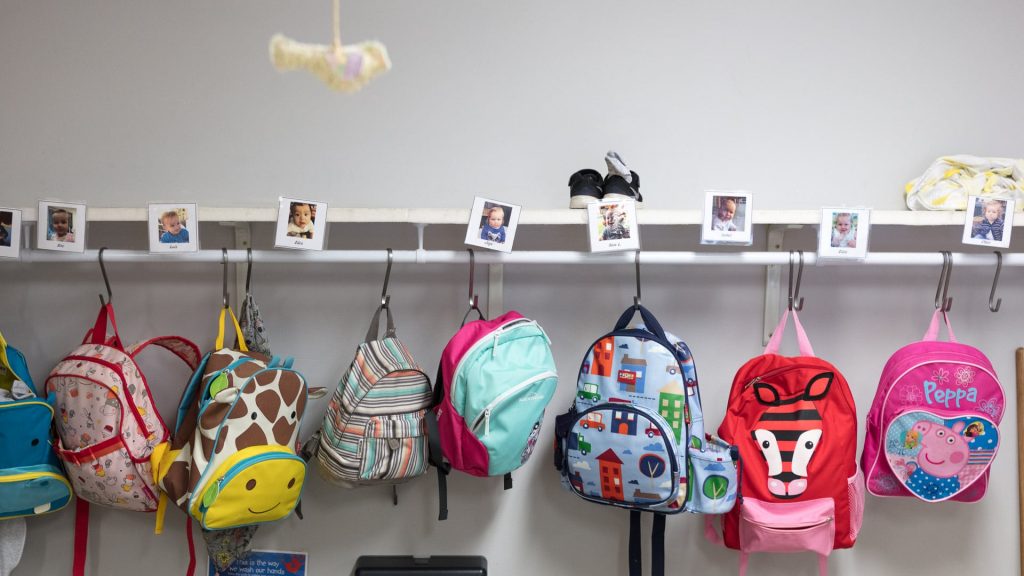
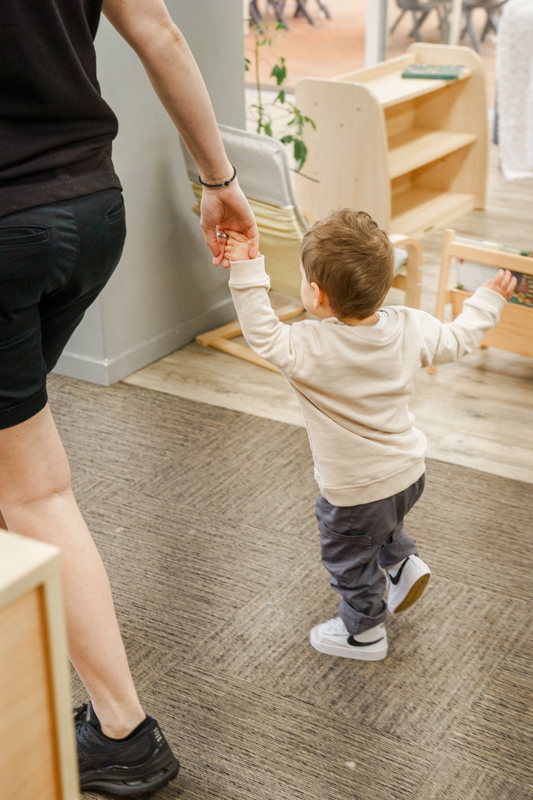
- Take your child on a tour of the room: Show them where their locker is, where their belongings will be kept and reassure your child they can access these throughout the day. Show them where the bathroom is and/or the nappy change areas depending on your child’s stage of development. Point out the similarities and differences to familiarise them with the surroundings.
- Recognise their feelings: If your child or baby is cuddling you tightly, soothe them and calmly talk about what is happening. If your child begins to cry take a moment to sit with them and calm them down. Reading a book together can be a good distraction and help settle them into the environment.
- Keep calm and say goodbye: It may be tough, and there can be the temptation to sneak off, but a calm goodbye with a kiss and cuddle at drop-off, even if your little one is in tears, is what experts recommend. Avoiding a drawn-out goodbye makes it easier for you both and avoids confusion for your child. It is helpful to give your child an identifiable timeline for your return (e.g. ‘After afternoon tea you will have a play and then I will be back to pick you up,’ rather than ‘I’ll be back soon’). Maintain your trust in the professionals you have chosen for your child. They will acknowledge and comfort him or her, supporting them to settle in and begin to explore new experiences and friends.
- Give them a family photo: A photo or small album of photos of your family can be a great comfort for your child in care and also a great way to foster a link between home and care environments as the educators can engage in conversations with your child about their family. It may also be helpful for your child to have a transitional object – such as a comforter or special toy – to help them feel secure during this early stage.
- At pick up: Don’t be alarmed if your child becomes distressed when you return to pick them up. It has been a big and emotional day for them on their first day/week of care and they are happy to see their families return for them.Encourage your child to wave or say goodbye to their educators to continue to foster a positive relationship. Remind your child they will be returning to school tomorrow or another day.
- Debrief and discuss: Educators will be happy to share with you an update from your child’s day on pick-up. It’s important to continue the conversation with your child, asking questions about their day and learning about their feelings as they embark on this new phase. Positive conversations will help your child adjust and understand the experience, while making you feel involved in their development.
- Be prepared for the next day: If your child has had a great first day with no tears when you left, be prepared that it may be different the next day you come to care. The first time it was all new and exciting, the second time they recognise a routine is forming and might not want another day away from their family. If they do become upset, follow the same routine and be consistent in your approach.
COMMUNICATION
Every child and family is unique, so communication is the most effective way to navigate this milestone. This experience is new, but it can also be exciting, and should be nurtured with the positive attention that it deserves.
Talk honestly with each other at home, and draw on the support of the educators, who are highly experienced with the challenges of families and children encountering new routines.
As you work together with your early childhood service, you will feel informed and empowered by the experience, so that you can be the best support to your child as they grow and adjust.
“When we feel safe, we explore, we learn, we grow”.
— (Kids Matter, Australian Early Childhood Mental Health Initiative)
Did you know?
More than 44 per cent of NSW children are not developmentally on track when they start school, according to the latest Australian Early Development Census, an Australian government initiative that measures how children have developed by the time they start school.
The census looks at five key areas of early childhood development: physical health and wellbeing, social competence, emotional maturity, language and cognitive skills, and communication skills and general knowledge.
Language and cognitive skills saw the most significant shift in the most recent report, with the percentage of children who were ‘developmentally vulnerable’ in this area increasing from 6.6 per cent in 2018 to 7.3 per cent in 2021.
Not being developmentally on track can have significant and lifelong consequences for a child.
Why Early Childhood Education and Care Matters
The early years of a child’s life are critical for their cognitive, social, and emotional development. This period is marked by rapid brain development, where the foundations for future learning, health and wellbeing are established.
Research has shown that participation in high-quality early education and care leads to better outcomes at school and later in life.
“The first five years of a child’s life are vital for their health, development, learning and wellbeing. Children who participate in quality early childhood education and care, and who get the right support services, such as health and development checks, are more likely to succeed at school and have improved lifelong educational, social and economic outcomes.”
Reference: ‘Putting a Value on Early Childhood Education and Care in Australia’

In the report ‘Work and Play: Understanding how Australian Families Experience Early Childhood Education and Care‘, 83% of parents said that educators and carers have a significant impact on young children’s learning and wellbeing.
“Parents clearly see the early childhood education and care sector’s value in providing an environment of support and growth and setting children up for success at school and beyond, with this belief strengthening as their children approach school age,” states the report.
Preschool options for your child
The two most popular options for preschool are Community Preschool, or a preschool program within an Early Childhood Education & Care (ECEC) service. ECEC services are often referred to as daycare/childcare centres but these are outdated terms that can cause confusion about what the services actually offer.
Similarities between Community Preschool and ECEC Services:
- University and tertiary qualified educators – with the same minimum standards set by the government for teacher qualifications and educator/child ratios.
- Deliver a curriculum based on the national Early Years Learning Framework.
- Allow families to access government fee support.
- Are regulated under the National Quality Framework, Australia’s system for regulating early learning and school age care.
Differences between Community Preschool and ECEC Services:
Opening hours
- Community preschools usually operate on school hours (9-3pm) and school terms/holidays, meaning they are open approximately 41 weeks per year. This may be challenging for working families. Generally, due to the more structured nature of the program, families will have less flexibility and choice regarding which days their child can attend the service.
- ECEC services are open longer hours to suit working families (approx 10-11hrs per day) and operate during school holidays. Most services only close briefly over the Christmas/New Year period, meaning they are open 50-51 weeks per year. ECEC services generally provide more flexibility around the availability and choice of days the family would like to attend.
Hours of school preparation
- With the shorter daily hours and only 41 weeks per year of care, community preschools offer around 750 hours of preparation prior to starting school.
- By comparison, a preschooler in an ECEC service will have accessed approximately 1500 hours of preparation prior to starting school – double that of a community preschool.
Convenience
- A community preschool is only open to children aged 3-6 years. Families are generally required to provide morning tea, lunch, sheets for rest time, etc.
- Most ECEC services cater for children from infants up to 6 years, meaning families can access care for younger siblings in the same location. Services are generally all-inclusive, with nutritious snacks and meals provided by the service.
Early Education and Care benefits the whole family
Parents identify that the benefits of early childhood education and care accrues beyond the child to the whole family, and extend beyond the monetary benefit of income earned while young children are in education and care.
According to the report, ‘Counting the Cost to Families: Accessing Childcare Affordability in Australia; The Front Project’.: “77 per cent of parents surveyed agreed that access to early childhood education and care services is important for the mental health and wellbeing of the whole family.”
The Explore & Develop difference:
One of the benefits of choosing an Explore & Develop service is that they are independently owned and operated, with the owner onsite to oversee daily operations.
While every Explore & Develop service is tailored to the needs of its local community, they have the following important features in common:
- Educational play-based programs that support each child’s physical, social, emotional, personal, spiritual, cognitive and linguistic aspects of learning
- Children are supported in their social and emotional development – making friends, learning to share, co-operating, taking turns, building resilience, being independent and developing empathy for others.
- Children develop confidence and self-esteem through a sense of belonging to their service and their peer group.
- Beyond the classroom programs are offered, with a focus on connecting children with nature, sustainability practices and engaging with their local community.
- Partnerships are offered for families to be involved and connect with other families.
- High-quality, caring and qualified Educators and Early Childhood Teachers who have access to ongoing professional development programs designed to equip them with the knowledge and inspiration required to provide high-quality services.
Find an Explore & Develop service near you.
References
- Work and play: Understanding how Australian Families Experience Early Childhood Education and Care’ by K Noble & P Hurley (2021).
- 2021 Australian Early Development Census (AEDC)
- 2014 ‘Putting a Value on Early Childhood Education and Care in Australia’

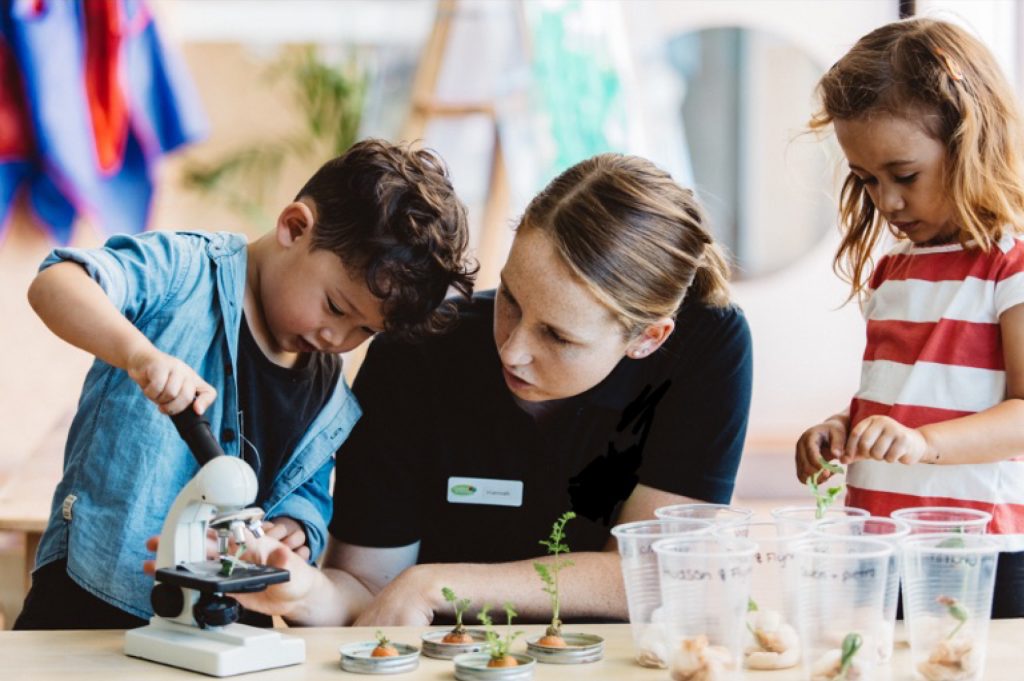
Childcare, daycare, early learning, preschool… however you refer to it, it is one of the most important decisions a family will make during the early years of their child’s life.
Due to its fundamental role in a child’s development, the early education and care sector has moved far beyond merely “childcare.”
Research by the NSW Government shows that 90 per cent of brain development occurs in the first five years of life. As the brain grows, it is strongly influenced by what is happening in a child’s environment and their interactions with people around them.
Enrolling your child in early education is a valuable opportunity to help them explore their world and develop new skills that will stay with them as they grow.
We know that choosing where to send your child can feel overwhelming. We support new families through the process every day, so have identified some important considerations to help guide you in making the right decision for you and your child.
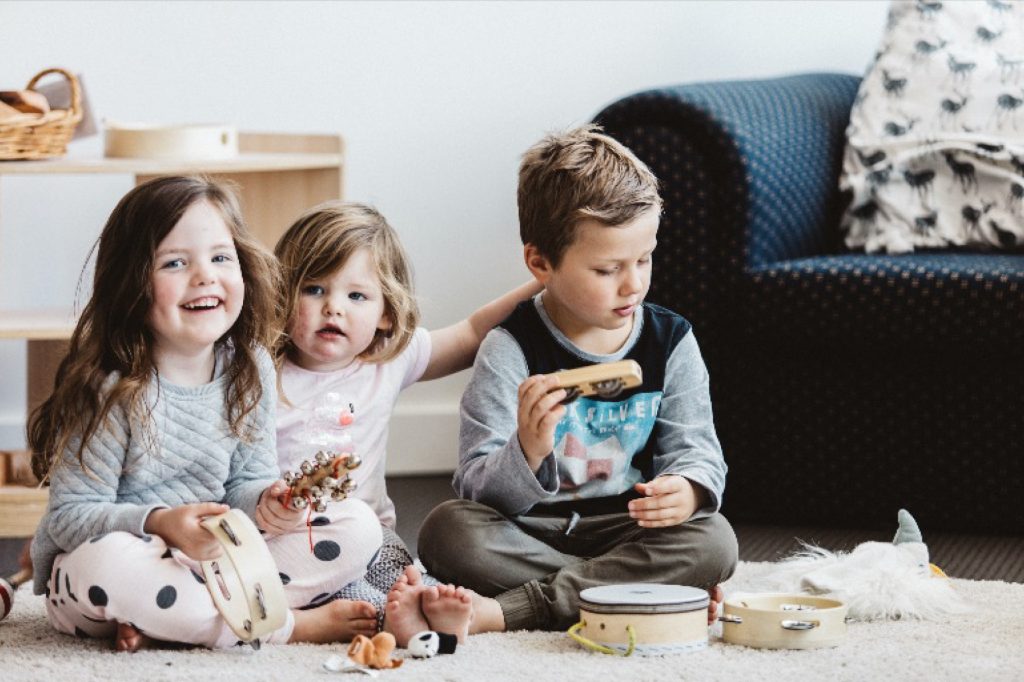
EARLY EDUCATION MATTERS, SO IT IS IMPORTANT TO DO YOUR HOMEWORK.
Types of care
There are several different options for early learning and care, all of which are covered by a national regulatory system known as the National Quality Framework.
The options include:
Early education and care services
This type of service is often referred to as daycare/ childcare centre/ long daycare.
However, these are all outdated terms that can cause confusion about what the services actually offer.
Led by university qualified early childhood teachers, these services provide early education programs, including preschool (transition to school) programs, along with offering extended hours to better accommodate the needs of working families.
These services operate during school holidays, and usually accommodate children from around 6 weeks to 6 years of age.
One of the benefits of attending early education and care services is consistency for children and families, as a child can begin in the infant or toddler group and then move through to the preschool age group, having developed a sense of belonging within the service and trusting, respectful relationships with their educators.
Community preschools/kindergartens
Community preschools offer education and care during school terms and school hours only, which may be more difficult for working families to manage. Generally, due to the more structured nature of preschool programs, families will have less flexibility and choice regarding which days their child can attend the service.
These services usually only accommodate children from 3-6 years of age.
Family daycare services
Family daycares offer small group care in a qualified early childhood professional’s own home.
These services tend to be more focused on providing family-style care and may offer children less opportunity for social development due to the small number of children at each service.
Quality and safety
All service types in Australia are regulated under the National Quality Framework and are monitored and assessed to ensure legal and quality requirements are met.
Ask the services that you’re considering what their ratings are in the seven National Quality Standard areas, as listed below:

Convenience
To ensure your choice of care is a successful one for your family, it is important to make sure it will be convenient for you on an ongoing basis.
Things to consider:
- Centre hours: Different types of services offer different daily hours, with early education and care services offering longer hours all year round – compared with community preschools that typically offer school hours only and are closed during school holidays. Consider what will best suit your working commitments.
- Inclusions: Some services include everything required (including lunch, drinks, hats, sheets and nappies) whereas others require you to pack a daily bag with everything your child needs.
- Location: To help narrow down the best location for you, consider how you will manage the daily drop off and pick up. Does the service offer lots of parking onsite, or is close to public transport? Is it located on the way to work, or close enough to home to make things easier?
- Other children: If you have (or plan to have) more than one child, consider whether a service that can cater to a wider age range would be more suitable for you over a number of years.
Educators
The National Quality Framework also sets out the minimum educator to child ratio requirements, and minimum qualifications of educators, for all early education and care services.
As part of these regulations, all services are required to have a minimum number of university qualified early childhood teachers, depending on how many children are being educated and cared for at the service.
Things to consider:
- Qualifications: What are the qualifications of the staff? Consider the mix of university-qualified teachers and staff members with vocational qualifications.
- Tenure: What is the average length of tenure? Low staff turnover is ideal for continuity of care and usually indicates a high-quality service that looks after its staff. Happy educators are better educators!
- Professional development: Does the service continue to invest in its people and offer an ongoing professional development program that ensures that educators’ skills remain current and best practice?
Management
Does the service director have the maturity and experience to enact decisions on their own and support you when you need it?
Is the service director an owner or an employee?
One of the benefits of choosing an Explore & Develop service is that they are independently owned and operated. The owner is onsite and able to oversee daily operations.
Our highly committed owners are constantly seeking to innovate their services to meet the needs of families and staff, and you have a direct point of contact if you have any concerns.
Not just anyone can become an owner of an Explore & Develop service. We look for early childhood professionals who are genuine in their desire to make a positive contribution to their local community by providing the highest quality early education and care services to children and families.

BOOK A TOUR
The next step is to make an enquiry and book a tour with the service. You may need to visit a few on your list to get a feel for the similarities, differences and aspects that you like the most.
Importantly, trust your instincts. You know your child best, and how they might respond to certain environments and people.
- Does it have a good feeling?
- Are staff friendly and welcoming?
- Do the educators act in a professional way?
Make sure you meet the qualified educators on your tour, especially the ones that will be looking after your child.

THINGS TO LOOK FOR DURING YOUR TOUR
On your visit, there are specific things you can look for and questions you may ask. These include:
Interactions
Establishing quality interactions between children, educators and families is crucial to achieving positive learning outcomes for children. As you walk around the service, observe how educators interact with children and one another.
- Do the educators speak respectfully to the children?
- Are the educators spending time engaging with the children calmly and on their level?
- Are the children happy and engaged?
- Are the children being comforted if they are upset?
Environment and safety
Look around the space and ensure it is adequately resourced for each age group. Children engaging in a range of play experiences is a positive sign.
Look for play spaces that are age appropriate and provide challenges for children to learn, play and develop.
Outdoor environments should extend and challenge not only children’s physical wellbeing, but also encourage children to take considered risks in their play, all the while developing their problem-solving abilities and building their resilience.
- What is the daily routine? Are there a variety of activities each day?
- Does the physical setting contain natural play spaces where children can explore, discover and develop connections with their environment?
- Is it a clean space? Do the educators model effective hygiene practices to reduce the spread of illness? Be careful not to confuse cleanliness with mess. Most play spaces for children will have spilled paint or toys on the floor. Children are engaged and learning when they are making a mess!
- Do toileting, nappy changing and rest times meet individual needs?
- How does the service utilise the outdoor learning environment?
The curriculum
Even though it is a group educational setting, educators should be planning for children’s learning on an individual basis through play-based experiences.
Literacy, mathematical and scientific concepts should be embedded into everyday programs. For example – educators singing, talking and reading with infants and toddlers as well as preschool children is crucial.
Children should be provided with hands-on learning opportunities, resources and materials to promote their development.
- How are children’s interests included in the program?
- How are families involved in the program?

HOW DOES THE CHILDCARE SUBSIDY WORK?
The Australian Government supports families in their choice to use childcare while they are at work by subsiding some or all their childcare fees. This is a means-tested system with more financial support for lower income families.
To be eligible for the childcare subsidy, families must provide the age of the child, the child’s immunisation status and the parents’ residency status. In addition, the chosen childcare service must be an approved provider.
Approved providers include centre-based care, family day care, outside school hours care and in-home care. It does not include community preschool/kindergarten.
Our child care subsidy calculator can give you an idea of how much subsidy you may be eligible for.

WHY CHOOSE EXPLORE & DEVELOP?
At Explore & Develop, we will guide you every step of the way and lead you into a partnership where you are a valuable contributor to your child’s learning.
We offer daily programs that reflect a calm, relaxed and unrushed environment for growing and learning. We value the commitment, dedication, and professionalism of our educators and their desire to give every child a great start in life.
All Explore & Develop services are individually owned and operated by passionate professionals who are on site daily, ensuring high-quality education and care.
We have services across NSW. Click on ‘Locations’ at the top of the screen to find the Explore & Develop service closest to you.
Follow us on Facebook and Instagram to stay up to date with our latest news and resources.

Playdough is one of our Educators’ favourite activities and has been a staple of the Early Childhood Education and Care setting for decades. Why?
Because of the range of developmental benefits it offers to children.
1. Sensory Development
Playing with playdough provides sensory stimulation and is a very calming experience.
It also provides proprioceptive input.
Proprioception is a sense of where your body is in space, which children require in order to develop skills such as balance, movement and how much muscle force to use.
2. Fine Motor Skill Development
When children use their hands, fingers, and tools to pound, push, poke, shape, roll and cut the playdough, they are developing the small muscles in their fingers and hands.
Through these manipulations, children also develop their hand-eye coordination.
These are both critical areas of physical development for writing, drawing, playing, eating and many other purposes.
3. Creativity & Imagination
Using playdough supports children’s capacity to be creative and develop their imagination skills.
Creativity is a very important life skill that helps children develop strategies to overcome problems and find solutions.
Playdough offers open-ended play, which stimulates curiosity, another important life skill and character strength.
4. Social & Emotional Skills
Creating with playdough supports children to feel competent and proud of their accomplishments.
It is a great outlet for children to express their emotions.
Playing with playdough in small groups and/or with adults presents lots of possibilities for talk and discussion, playing collaboratively, problem solving and planning with others.
5. Literacy & Numeracy Development
Through playdough, children build their vocabulary and practice listening to and talking with friends, siblings, and adults.
When making a batch of playdough, children start to understand the purpose of written language. Following the recipe instructions helps children to connect written and spoken words, to learn that writing can be used for different purposes.
When children play with playdough, they are measuring, counting, sorting, classifying and learning about shapes, weight and volume.
Playdough is also an excellent tool for teaching the alphabet, by having children form letter shapes with the playdough or experiment with alphabet cutters.
Homemade Playdough Recipe
Ingredients:
1 cup of flour (any kind)
1/4 cup of salt
1 Tablespoon cream of tartar (optional)
1/2 cup warm water
1/4 teaspoon non toxic food colouring powder
(Note: if you don’t have colouring powder, you can also use a drop of non-toxic gel or liquid colouring. Just make sure you mix it thoroughly!)
Method
- Wear a suitable apron or smock, as the dye colouring may stain.
- Mix the flour, salt, cream of tartar and colour in a mixing bowl.
- Slowly pour 1/2 cup of warm water into the flour mixture, stirring as you pour.
- Stir until combined, then knead with your hands until the flour is completely absorbed.
- If the dough is too sticky, add more flour until it doesn’t stick at all.
- Have FUN!!!
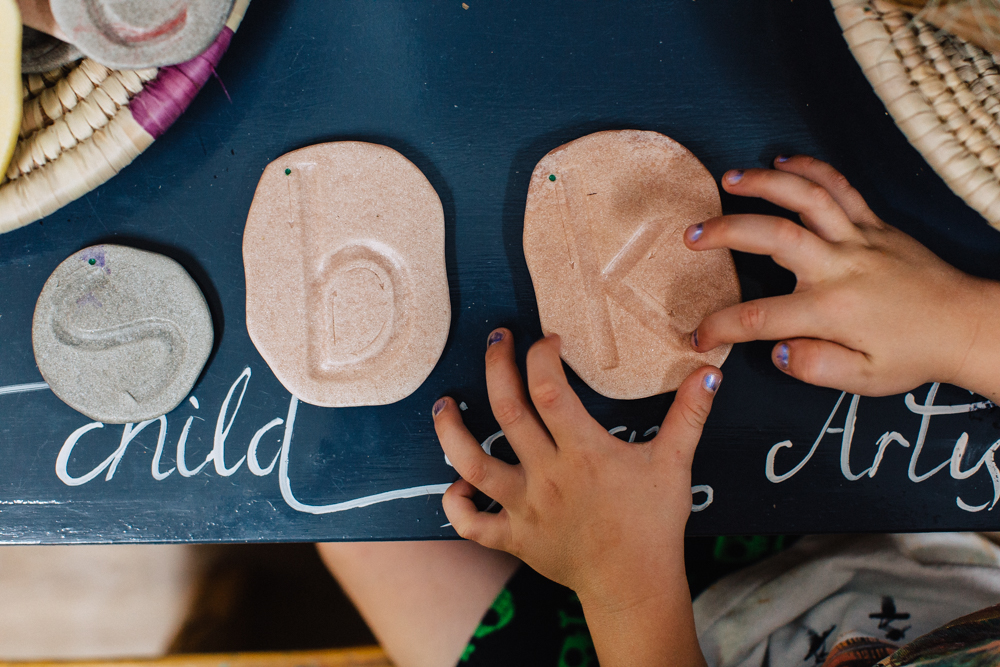
How do I teach my child to read? At what age should my child learn to write? How do I support my child’s literacy development?
These are all great questions that our educators at Explore & Develop are frequently asked by parents and caregivers.
When referring to literacy in the early years, school-age children may come to mind. However, research shows that language and literacy development actually begins from birth.
As babies begin to interact with the people around them, they start to learn how language works and gain an understanding of how to communicate effectively. Through play, children can transfer this knowledge to other contexts. As their literacy skills develop, the begin to connect spoken language to written language.
Research suggests that children who grow up in literacy-rich homes are more likely to do better at school, meaning that parents and caregivers play a vital role in supporting early literacy development.
Reading to your child, using a large range of vocabulary, providing drawing materials, spending time playing games and singing are all simple things you can do to help your baby, toddler or preschooler develop their literacy skills.
At Explore & Develop, educators focus on using language in all its forms. We strongly believe that singing, talking, reading and drawing with children of all ages is crucial and will lay the foundation for spoken and written communication to emerge.
Read on for some simple ways to help support your child’s literacy development at home across the core areas of:
- Communication
- Reading
- Writing
COMMUNICATION
Oral (spoken) language forms the foundation for literacy, as children begin to understand the meaning of words and sounds. This is when phonological awareness begins to develop.
A child’s understanding of spoken words will later translate to understanding written language, therefore making them more competent in decoding different texts.
Language learning begins at birth and there are many ways families can support this.
Babies to toddlers:
- Copy the sounds and facial expressions your baby makes. Speak slowly and emphasise the rise and fall of the sounds. Talk to them often from day one.
- Sing with your child, even if you are just making up the words. Sing nursery rhymes if you can as they teach rhythm, rhyme and repetition.
- Talk about everything you are doing and point out interesting things you see around you, including words to describe emotions.
- Have fun with words that rhyme and words that describe a sound, such as animal and vehicle noises.
- Listen to your child. Respond to your toddler’s questions but avoid jumping in with the answer all the time. For example, if your child asks, ‘What’s that over there?’ You could say, ‘What do you think it is?’
Preschoolers to school-age:
- Play rhyming games such as ‘Can you think of words that sound like ball?’ Hall, fall, small etc.
- Play games such as ‘I Spy’ using the first letter of a word or a colour.
- Talk about the past and future – things your child can recall and activities they are looking forward to.
- Share stories at mealtimes, make up stories at bedtime, sing songs and have fun with silly language!
READING
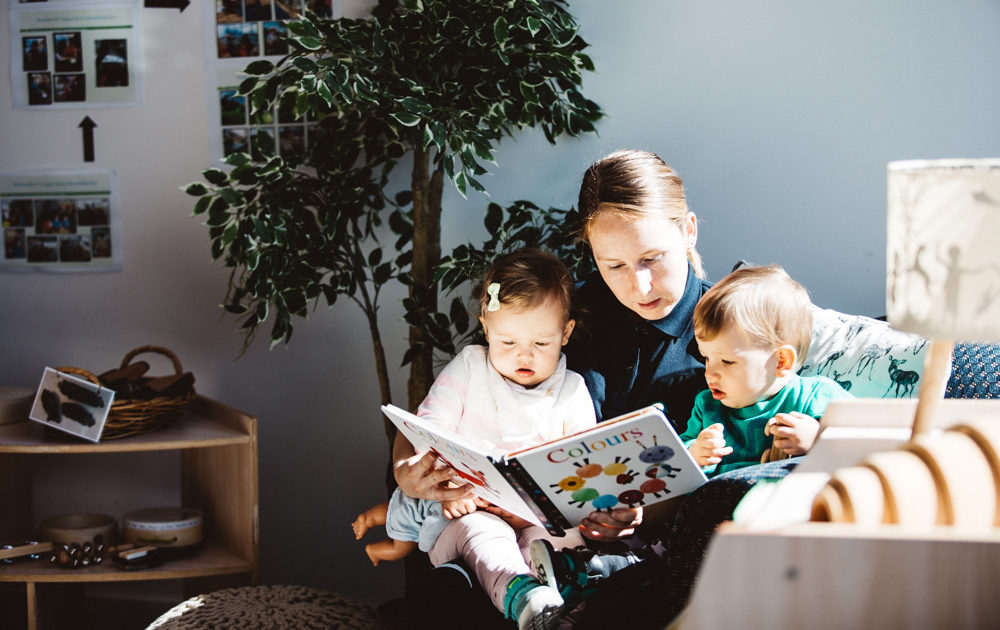
Children will begin to read by looking at the pictures, pointing out and naming familiar objects, noticing patterns such as rhythm and rhyme and then later, recognising letters and words in the text.
Lots of experience with books from birth will help them on their journey with reading.
Babies to toddlers:
- Read aloud with them every day. When reading books, make the animal sounds, be animated, have fun! They will learn that books are pleasurable.
- Point out objects and actions in the pictures, to teach them that words are coming from the page.
- Very young children are sensory learners, so choose ‘touch and feel’, ‘lift the flap’ and board books as well as books with repetition.
- Encourage your child to dramatise the actions in the book such as hopping like a kangaroo.
Preschoolers to school-age:
- Point to the words as you read them, to teach them that English is written from left to right. If they are ready, you could also ask them to find a familiar letter in the words.
- Choose different types of books, such as factual books that can answer questions about topics they are interested in. This demonstrates that books provide information, plus gives them opportunities to problem solve and advance their vocabulary.
- Ask them questions about the story. ‘What was the story about?’ or ‘Why do you think he did that?’ or ‘What would you do in that situation?’
- Involve children in reading rhyming books by encouraging them to finish the sentence.
- Point out words found in places other than books – such as on street signs, food packaging labels, public transport and posters at the shops.
- Clap syllables of words.
- Invite your child to make their own story book. Encourage them to think of a storyline, create illustrations and write their words down for them.
- Read your child at least one book a day, give them books to enjoy by themselves and take them to the library from time to time. Above all, this stage is about showing them that reading should be fun.
“The fire of literacy is created by the emotional sparks between a child, a book, and the person reading. It isn’t achieved by the book alone, nor by the child alone, nor by the adult who’s reading aloud—it’s the relationship winding between all three, bringing them together in easy harmony.”
Mem Fox
WRITING
Before a child can learn to write, they first need to begin making marks such as scribbles, lines and circles with a range of materials. There is no rush and you can support each step of the process in many ways.
Babies to toddlers:
- Provide babies and toddlers with many opportunities to paint with their hands.
- Provide drawing materials such as chubby crayons, markers and pencils and give them time to explore them independently.
- Make marks in the outdoor environment using chalk on the pavement, fingers and rakes in the sand, sticks in the dirt or water with paintbrushes on the fence.
- Show an interest in the marks your child makes. Comment on the patterns and colours they have used.
- Provide them opportunities to paint with brushes both inside and outside, on the floor and at an easel. Compliment them on their effort and display their work with pride.
Preschoolers to school-age:
- Encourage drawing with a range of materials and begin to introduce new ones such as finer markers, triangular pencils, charcoal and oil pastels.
- Add drawing opportunities during play, such as adding a book to their their doctor set or a notepad next to their toy phone.
- Invite them to write their name on birthday cards, even if it is an unrecognisable mark.
- Involve them when you are writing a shopping list.
- Encourage them to talk about their drawings with open ended questions, for example, ‘Tell me about your drawing’. This allows them to describe their marks and symbols in their own way. Even better, write their words down for them and then read it back to them.
- Invite them to write their name on their artwork, even just their first letter. Or with their permission, write it for them while they are watching.
- Provide materials to play with that have letters on them, such as alphabet puzzles, letter blocks, magnetic letters on the fridge and magazines for cutting.
- Invite your child to make their own book with illustrations and write some words if they are ready.

We hope you have lots of fun using some of these simple tips and activities to help build your child’s early literacy skills.
For more helpful articles and advice, visit our Resource Library here.
If you’d like to find out more about how we can help support your child’s early literacy skills, contact your closest Explore & Develop Service. All of our Services are owned and operated by local early childhood experts, who are onsite daily and committed to your child’s safety and development.
Follow us on Facebook or Instagram.
References:
Department of Education & Training (2022). Belonging, Being, Becoming – The Early Years Learning Framework for Australia v2.0.
Explore & Develop Transition to School Program Booklet
Fox, M. (2001). Reading Magic: Why Reading Aloud to Our Children Will Change Their Lives Forever.
Mielonen, A. & Paterson, W. (2009). Developing Literacy through Play. Journal of Inquiry and Action in Education 3(1).
Phillips, L. & Harris, P. (2017). How to encourage literacy in young children (and beyond) – https://theconversation.com/how-to-encourage-literacy-in-young-children-and-beyond-80459
Raising Children Network – raisingchildren.net.au (Developing Literacy/Literacy Activities)
Strickland, D. & Riley-Ayers, S. (2006). Early Literacy: Policies and Practice in the Preschool Years. National Institute for Early Education Research. Issue 10.
Did you know?
One of the major concerns parents have about starting their child at an early childhood education and care service is that their child won’t settle and adjust to care.
Children develop a sense of belonging through their relationships with family, their community, the culture around them and the places they experience. At Explore & Develop, we take the time to get to know your child and family. Building respectful, supportive relationships and creating a space where your child can feel a sense of belonging that inspires them to grow and learn is our priority.
Explore & Develop’s enrolment and orientation process is an important part of supporting a sense of belonging for children and families.
Our orientation program helps to make the transition from home to the service as smooth as possible, with the aim to maintain continuity between the home and the service. It is an opportunity to get to know each child and their family, building respectful relationships.
Our Educators put a great deal of thought and attention into creating a space for children and families to feel welcome and have a sense of belonging. A space and environment that communicates the message, ‘you are welcome, you are wanted, you belong’.
Making the connections to belong
Children quickly learn how to be with others in the safety of their homes, neighbourhoods and early childhood education and care services, and their early experiences of being warmly acknowledged and responded to provide them with opportunities to become involved with and to get along with others.
Getting along with others means many things. It means listening and being heard. It means sharing and taking turns. It means being able to negotiate, compromise and work things out. Getting along means feeling valued and helping others that you’re with to feel valued too. It’s about trusting others and enabling them to trust in us.
The most significant relationships in a baby’s or child’s life are reinforced every time someone responds to them promptly in a predictable, gentle and caring way. Babies and children learn to trust those they most need – to support them in learning about the world and what it means to belong. This is why it’s so important that adults – caregivers and Educators who spend time with babies and children – become attuned to their communications and respond promptly.
Getting along with others is based on secure attachments and sensitive, responsive relationships with reliable, nurturing adults who use everyday experiences to model thoughtful interactions.
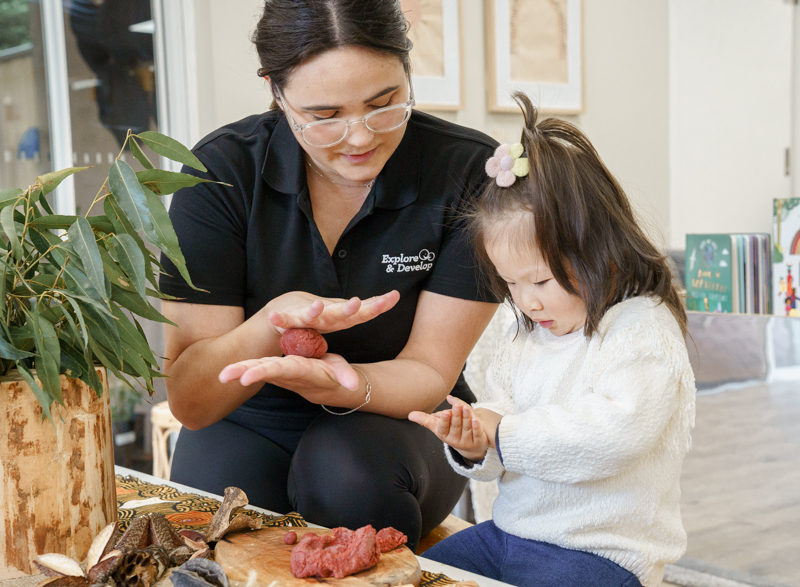
What happens at orientation?
Explore & Develop’s orientation programs are planned in consultation with families. Generally, orientation consists of several visits to the service. The visits include spending time with your child and in your child’s room, getting to know your child’s Educators, the daily routine of your child’s room, the service philosophy, educational program and how Explore & Develop ensures two-way communication with families.
As well as telling you about us during your orientation visits, we want to know about you and your family, your values, culture and expectations, your child’s strengths, interests, concerns and routine at home, so as to ensure we provide the best possible education and care for your child.
Throughout your time at Explore & Develop, and particularly as your child starts with us, our focus is on building a reciprocal partnership with you. We invite, encourage and value your input. This helps us create a secure, personalised experience for your child, which in turn will make them more engaged, motivated learners and more likely to reach their full potential in life.
How is your child’s sense of belonging extended?
As your child’s social world expands, with new friendships, and as they participate in larger groups, they increasingly need to feel secure in the world beyond their home. Knowing how to communicate with others and how to be with others in mutually satisfying ways becomes increasingly important for them.
Getting along with others in larger social groups can prove tricky, but is achievable when children are supported by Educators to understand their own feelings and to be thoughtful about the feelings experienced by others. Early learning about belonging and getting along with others is highly dependent on the modelling demonstrated to them by the significant people in their lives.
‘Deep connection with others is the basis for a real sense of belonging. Supporting children to get along with others is a significant aspect of caring for and educating children at home and in early learning settings.’
Carmel Richardson, Author of ‘Belonging: At the Heart of Relating to Others’
Consistency of care
With each Explore & Develop service being owner operated, there are many positive ‘flow on’ effects. It creates a strong, nurturing environment for Educators and families alike. The Educators benefit from the stability of a motivated leader who cares for their professional development and actively develops their career; who renumerates above award rates, and accommodates for work-life balance. The families have an accessible leader who is on-site, knows each child and family well, and is always available and present.
The starting place for this journey is by booking a tour and later attending an orientation visit with your child. Building secure, individualised attachments in relationships takes time. It takes trust, interest and and connection.
References:
- Early Years Learning Framework 2022-V2.0.pdf (acecqa.gov.au)
- ‘Belonging: At the heart of relating to others’ by Carmel Richardson and produced by Early Childhood Australia, Volume 13, Number 2
- ‘Pedagogy in Practice’ downloadable ebook from Explore & Develop

Hello,
I’m excited to report that Explore & Develop recently engaged Tresillian’s Professional Practice and Innovation Centre to deliver training to Explore & Develop Educators on ‘Safe Sleep and Responsive Settling for Infants and Toddlers.’
Explore & Develop has enjoyed a partnership with Tresillian since 2019 and we are very excited to be an Early Learning service provider to be offered the Tresillian training in Australia!
Tresillian is known as the ‘go to’ place for specialist parenting advice, offering guidance to parents on baby’s sleep and settling, feeding and toddler/preschooler behaviour, along with supporting parental mental health.
I hope that this is one of many more professional development sessions for our Educators and staff.
Kind Regards.

Belinda Ludlow
CEO of Explore & Develop

Reading the non verbal cues
One of the first things you learn with a baby is to look out for ‘tired signs’ so that you can put your baby to bed before they become overtired. This is good advice because an overtired baby gets grumpy and doesn’t feed well or enjoy play and social times.
But, even so, looking for tired signs can sometimes be confusing because they can easily be mixed up with ‘I just need a break’ cues. And, if this happens, new parents can accidentally put their baby to bed when they’re not ready, which can then cause problems settling them.
‘The First Three Months’, a book by Fran Chavasse and Nicola Brown, guides parents on how a baby’s brain controls their sleep, telling their body when it’s time to sleep.
The book also reveals how at each stage of a baby’s development, the Tresillian Sleep Formula, along with their non-verbal cues, can be used to determine whether a baby is tired and ready for bed.
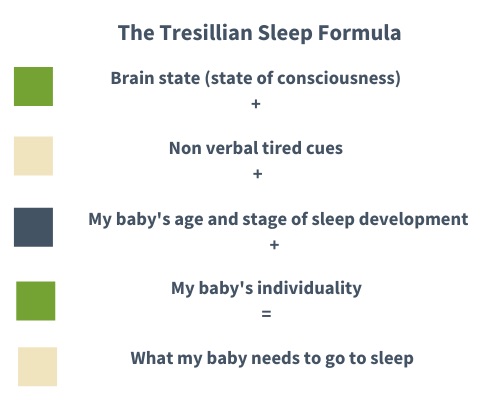
The Sleep Formula formed an important part of the recent ‘Safe Sleep and Responsive Settling for Infants and Toddlers’ workshop, which focused on:
- Current recommended practices in safe sleep and responsive settling for infants and toddlers,
- Re-thinking tired signs, responsive settling strategies and when and how to intervene with sleep difficulties.
The professional training builds on the existing expertise that our qualified Educators have, and will equip them with best-practice of when and how to intervene with sleep difficulties, identification of tired signs and effective settling strategies.
The additional knowledge that our Educators gain will be put to good use daily in settling babies and toddlers at our Explore & Develop services, in conjuction with supporting families with their individual routines.
“At each age and stage of a baby’s development, the Sleep Formula can be used, along with non-verbal cues, to determine whether a baby is tired and ready for bed. The more carefully you watch your baby, the more you will learn about your baby’s individuality.”
Fran Chavasse and Nicola Brown in ‘The First Three Months’
Settling babies over six months of age
It’s not just infants that need assistance with settling and sleeping. Reassurance and support can be given to babies older than six months while helping them to discover their own way of going to sleep. This can be achieved by:
- Talking quietly and cuddling your baby, which can help make them calm.
- Putting your baby on their back in the cot awake (when they are calm/drowsy).
- Comforting your baby with gentle ‘ssshhh’ sounds, gentle rhythmic patting, rocking, or stroking until baby is calm or asleep.
- As your baby calms, moving away from the cot or leaving the room.
- If your baby starts to become distressed, returning and comforting your baby before moving away or leaving the room again.
- You may have to repeat the steps above several times before your baby is able to settle to sleep. As your baby learns to settle, it will take less time to calm your baby.
Most babies take time to settle and it’s helpful to use the same options every time when establishing a good sleep habit for your baby. More information on strategies to assisting babies and toddlers to sleep can be read here.
References
- ‘The First Three Months’ A Tresillian guide to caring for your newborn baby by Fran Chavasse
- ‘The Importance of Sleep’ Parent Resource from the Explore & Develop web site

Hello,
It is fantastic to see 80 per cent of the population of NSW being double-vaccinated. This is a great step in protecting vulnerable people in our communities and a big help in getting life back to normal.
Of course, during the pandemic, the Early Childhood Education and Care sector became an essential service and our teams adapted to the challenges of working on the front line.
I am really proud of the efforts of everyone in the Explore & Develop community – educators, children, parents, and of course our franchise owner/operators over the last few months for doing everything possible to maintain a safe environment for all.
In this newsletter I would like to share the latest research on the impacts of COVID-19 on young children and what role families can play to help keep them safe.
I am also happy to share some positive changes that have been made to the Child Care Subsidy that will provide greater financial support for some families.
I am looking forward to a brighter 2022 where we can enjoy all the freedoms whilst staying safe.
Kind regards.

Belinda Ludlow
CEO of Explore & Develop

Risk -v- Benefits
It is mandatory for all Early Childhood Educators and staff across NSW to have received two doses of COVID-19 vaccination by Monday 8 November 2021 and all Explore & Develop services will be compliant with this requirement.
Explore & Develop services follow the current requirements and advice of NSW Health and take all necessary precautions to minimise the risk of further transmission of COVID-19 in our service community.
In addition to vaccinations, our Explore & Develop services have implemented a number of control measures that have included increased cleaning and hygiene practices and altering requirements to drop-off and pick-up procedures to suit each specific location.
Recent data published by the National Centre for Immunisation Research and Surveillance (NIRS), with the support of the NSW Ministry of Health and NSW Department of Education looked at the transmission of COVID-19 in schools, early childhood settings and households in 2020 and 2021.
The research concluded that although most children in this study had no or mild symptoms from COVID-19, however, household transmission was a much more pressing issue.
The report findings indicated that the impact of cross contamination of COVID-19 for children that attended an Early Childhood Education and Care service or school, was the highest in the family home. In their studies with this age group, they found 70.7 per cent of overall transmission was among household contacts.
Additionally, the Murdoch Children’s Research Institute recommends that to protect children and adolescents in the community and keep schools and Early Childhood Education and Care services open, we should encourage parents and adults of all ages to be vaccinated now.
We are confident that this, in combination with support from our community, will minimise risk and help to keep the Explore & Develop services open and children learning face-to-face beside their peers. This is so important, as we know that children’s brains develop connections faster in the first five years than at any other time in their lives.
A child’s participation in an organised Early Childhood Education program assists in the development of their cognitive abilities and also enhances their social and emotional skills while they interact with their peers.
In fact, “full participation in education is essential for children to learn and develop socially, but also for family and societal functioning,” says Doctor Archana Koirala, Paediatric Infectious Diseases Specialist at the University of Sydney.
Ultimately our priority is to minimise risk as much as possible, so that all children and families can experience the benefits of Early Childhood Education and Care.
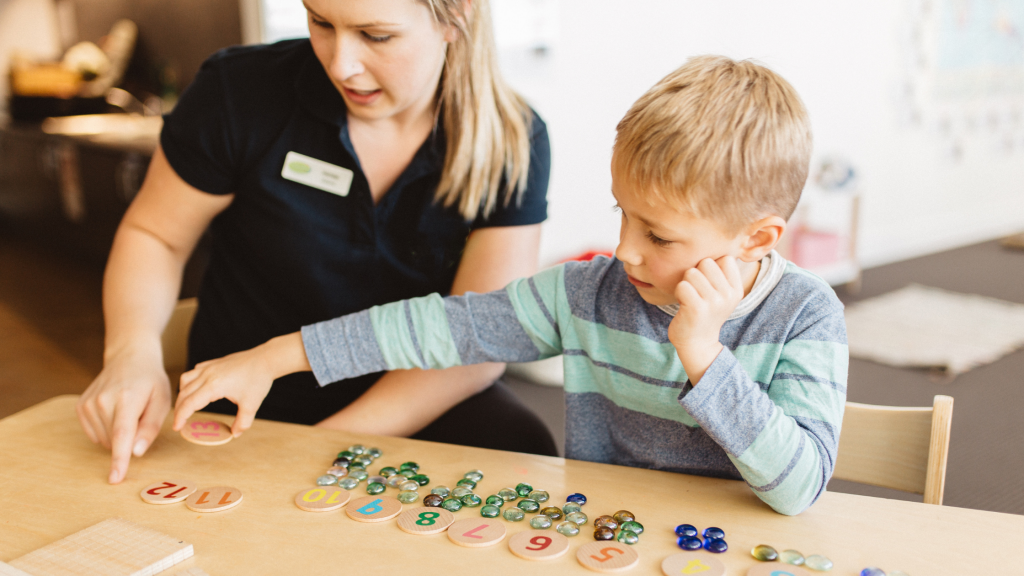
Increased Child Care Subsidy Support
Under the current Child Care Subsidy arrangements, the Federal Government capped the maximum benefit that it contributed to the cost of child care at $10,665 per year for families that earned over $190,015. However, from Friday 10 December 2021, this annual cap will be removed, meaning that more families will be able to benefit from this increase in funding.
This is an important change, as many families would cease receiving Child Care Subsidy half way through the year and were required to cover 100 per cent of the cost of care for the second half of the year. As a result, some families were forced to limit the amount of days that their child or children attended, by either seeking care by other means, or limiting the number of days of workforce participation.
In addition, from Monday 7 March 2022, families with more than one child may be eligible to receive a 30 per cent higher subsidy, up to a maximum of 95 per cent subsidy for the second and younger siblings. This increased subsidy is available for families earning less than $354,305 per year, who have more than one child aged five or under, who attend Early Childhood Education and Care.
If you would like to estimate how the increased Child Care Subsidy will affect your child care fees (as of Friday 10 December, 2021) please utilise the Explore & Develop Child Care Subsidy Calculator.
We are encouraged that these changes to Child Care Subsidy will be implemented, assisting to make Early Childhood Education and Care more affordable and accessible to families.
References
- COVID-19 Vaccines Frequently Asked Questions
- Murdoch Children’s Research Institute
- COVID-19 Delta Variant in Schools and Early Education & Care Services in NSW Australia Report